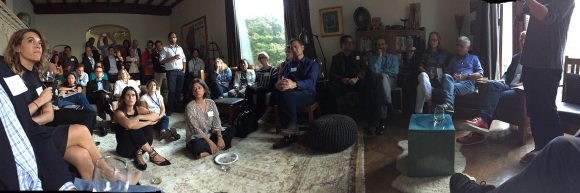
Every SOCAP leaves me wondering what its like outside the West Coast, and specifically outside of San Francisco and Seattle, which seem to be leading the way into the world of impact investing and conscious companies.
How does your city compare?

Every SOCAP leaves me wondering what its like outside the West Coast, and specifically outside of San Francisco and Seattle, which seem to be leading the way into the world of impact investing and conscious companies.
How does your city compare?

Last month, sitting in a monthly gathering of impact investors, in the midst of a discussion on why so few investments get made, a fellow member made a comment that I can’t get out of my head, “It’s not about dealflow, it’s about investorflow.” The way startups usually get funded is not how entrepreneurs think. It’s not a meritocracy. It’s not like an...
Philanthropy does an amazing amount of good in the world. However, when philanthropy finds a solution to a problem, the solution only scales through yet-more philanthropy. In contrast, when a for-profit company finds a solution, the profits from the solution pay for more. In a world where 7 billion people have access to a Coke within a half day’s walk, the same should be true for clean...

A key tenant to the Lean Startup philosophy is the repeated cycle of learning. Launch. Measure. Learn. Repeat. Too often, first-time entrepreneurs think they know the right answer, when in fact they don’t even know the right questions to be asking. For successful established companies, this cycle of learning never stops. Case in point today, when Fledge took a field trip to visit...

Outside of California, where it feels like all investors are professional investors, and following up on last week’s post about one difference between Angel and professional investors, another difference is the way the deal terms get set, especially valuation. First-time entrepreneurs don’t understand how startups gets valued. Neither do first-time startup investors. In my MBA class...

The more one dives into startup investing, the most one finds Catch-22’s. This post is about the tradeoff between being inventive and copying a known business model. Novelty. The risk-averse investors who make the high-risk investments in startups tend to like new ideas. They are early adopters of new ideas and new technology. They enjoy the excitement that comes with novelty and...

In the 21st Century, companies need to experiment to survive and thrive. This is even more true for startups, where the first idea to work may not be the best idea for the long run. With this in mind, my business accelerator, Fledge, ran an experiment this Autumn… FledgeX, an 100% online version of our intense entrepreneurial training program. The results were not entirely as expected. Time The...

The last time I presented at an event for investors, the first five people all asked me the same question, “Any exits yet?” The more years I spend focusing on revenue-based investing, the more that question is getting on my nerves. Perhaps some of that is on me, as the talks I give are generally titled “Investing without Exits” or “Alternative Exits” or...

What is the story with the unicorns? Is there a tech investment bubble? What on earth is going in in the venture investing world? The short answer is that we’re at a crux of a paradigm. The paradigm wrapped around investing venture capital in startups. Few people I talk to know that venture capital, as practiced today, is a fairly new concept. People instead assume...

In the last post, I talked about how revenue-based investments are a lower cost of capital than traditional equity. In this post, as promised, I’ll explain how they also better align the the incentives of investor with the entrepreneur. To start with, always remember to put yourselves in the other person’s shoes when raising money. Investors invest to make a positive return on their...