CategoryEconomics

Myths and assumptions of tulips

One of the best parts of Debt: The First 5,000 Years was pointing out the myth that economies always begin with barter (hint: they never have). Similarly, whenever a market starts to heat up, we inevitably hear about the tulip bubble in Holland in the 1630’s.  Well… turns out those stories are myths as well.  Anne Goldgar has written a book, Tulipmania: Money, Honor and Knowledge in...

A No-Lose Lottery

The staff at the Freakonomics podcast does an amazing job of uncovering interesting business ideas.  Two weeks ago the episode was “A No-Lose Lottery“. The idea is incredibly simple, but feels enough like a lottery that it is illegal in most countries.  It goes like this: Create a savings account, where the savers are guaranteed to not lose their savings (if not earn a small interest...

Hockey sticks are really S-curves

I love uncovering hidden assumptions.  One in particular gets written about every day in one form or another.  The high-speed growth of a handful of startups, of Bitcoin, and other “overnight successes“. Learn a bit of history, and you’ll discover that the steep adoption curve of any success is really just the middle of the story.  The beginning of the story is the (often long)...

Are We Running Out of Ideas?

Last month I pointed out that tech seems to be peaking, but social good feels like its in its infancy.  The “peaking” story has cropped up a few more times: Freakonomics recent podcast asks, “Are We Running Out of Ideas?”  This podcast, like the book it is named after, always does a good job analyzing the root causes rather than just skimming over the surface.  That root...

Fusion Economics, by Laurence J. Brahm

“First they will laugh at you; then they will threaten you; and then they will follow you” – Ghandi Back to my readings on economics and inequality, I found Fusion Economics sitting on my nightstand, shot right through it, and suggest you pick up a copy too. Laurence J Brahm is a real life Forrest Gump, but brilliant is as brilliant does.  Gump, as in his life seems to take him...

The Vicious Cycle of Inequality

When the University of Chicago’s Booth School of Business starts talking about the world being in a vicious cycle of inequality, you know we’re well into the end game.  From this blog post: Earlier this year, a Stigler Center paper by Luigi Zingales [Faculty Director of the Stigler Center] argued that market concentration can lead to a vicious circle, in which companies use market...

The Top 40% and the Bottom 60%

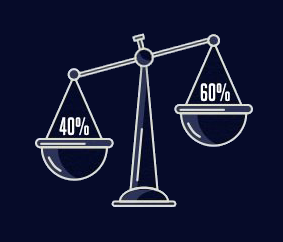
Ray Dalio posted a great analysis of the American economy, splitting it into two parts, the top 40% and bottom 60%. To understand what’s going on in “the economy,” it is a serious mistake to look at average statistics. This is because the wealth and income skews are so great that average statistics no longer reflect the conditions of the average man. For example, as shown in the chart below, the...

All the World’s Money

From the Visual Capitalist, an infographic that helps you visualize all the world’s money… I cut off the bottom of the original graphic, which is derivatives, as (a) that market is humongous, but (b) the net total of the trillions in derivatives is $0, as every buyer has a matching writer, and thus that is a zero-sum market, unlike stocks or housing or gold. Hopefully the Visual...

The Clean Money Revolution

I met Joel Solomon five years ago.  Someone pointed me to him as knowledgeable and experienced.  I knew of his work Renewal Funds, and a few years ago visited his Hollyhock on Cortes Island in British Columbia, Canada to attend his Social Venture Institute. (Disclosure: sometime in all that he agreed to invest a tiny amount into Fledge, one of my contributions to the field of social good.)...

Anti-Piketty?

After enjoying most of Capital in the 21st Century I couldn’t pass up reading what is clearly supposed to be a counter-argument: Anti-Picketty. It’s not one, but twenty-four arguments against Picketty’s conclusions and claims, by more than twenty-four economists and think tankers.  Despite 24 authors, this books is less than a half the length of Capital and despite a lot of...

Books

HardcoverThe Next StepThe Next StepThe Next StepThe Next Step The Next StepThe Next StepThe Next Step

Podcast

Fledge

Recent blog posts

Popular blog posts

Categories

Archives